
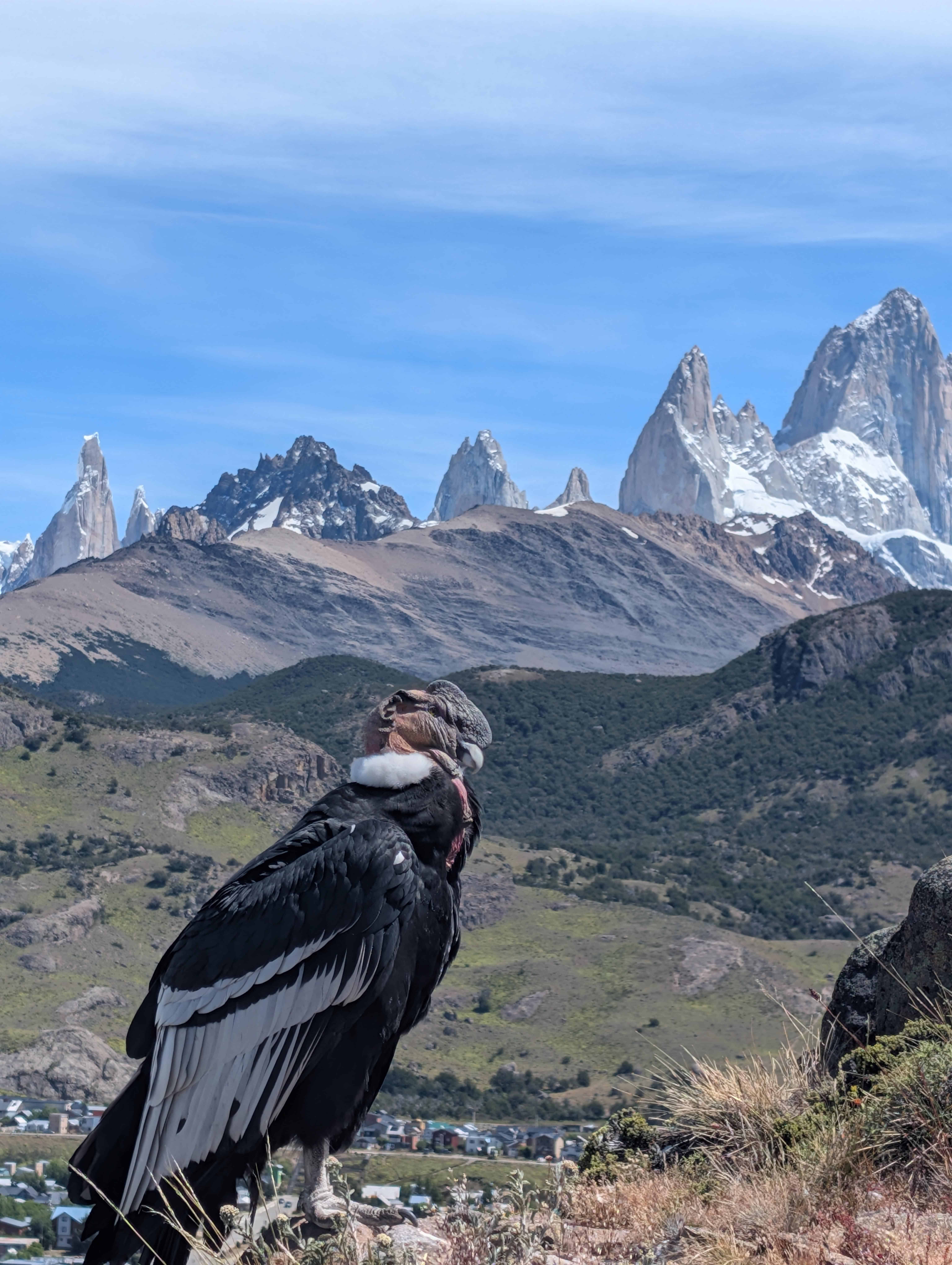
Characteristics of the Andean condor
The Andean condor (Vultur gryphus) is the flying bird with the largest wingspan on the planet. With outstretched wings that can exceed 10 feet (3 meters) from tip to tip and a weight of up to 33 pounds (15 kilos), it is an imposing presence in the Patagonian sky.
Despite its size, the condor is a master of effortless flight. It rides rising thermal currents—columns of warm air ascending from the ground—to glide for hours without needing to flap its wings. It can cover between 60 and 125 miles (100 to 200 kilometers) in a single day in search of food.
How do you tell a condor apart from other birds?
The adult condor has black plumage with a white band on its wings and a ruff of white feathers around its neck. Its head and neck are reddish and featherless—an adaptation for staying clean while feeding. Juveniles are dark brown and take 6 to 8 years to acquire their adult plumage.

Where to see it near El Calafate
The good news for visitors to El Calafate is that condors are relatively common in the area. There are several spots where your chances of a sighting are high:
- Cerro Frías: from the viewpoints of Cerro Frías, just a few miles from El Calafate, condors often appear riding the afternoon thermals. It's one of the most reliable spots to see them.
- Road to the Perito Moreno Glacier: along the cliffs lining Provincial Route 11 toward Los Glaciares National Park, it's common to see condors gliding mid-morning once the sun has warmed the rocks. Many travelers spot them on the way to the Perito Moreno Glacier walkways.
- Patagonian estancias: in areas where guanacos graze, condors circle in search of carrion. Estancia and glacier excursions from El Calafate often include spontaneous sightings.
- Mirador Rincón: overlooking Lago Argentino, this natural viewpoint is a favorite among nature photographers for the chance to see condors at eye level.
Thermal currents form between 10 am and 4 pm, when the sun heats the rocky ground. The ideal window is between 11 am and 2 pm, when condors are most active on their exploration and feeding flights.
Flight and behavior
Watching a condor in flight is an experience that moves even those who have seen it before. The combination of its size and the elegance with which it moves through the air—barely flapping its wings—creates a sensation of weightlessness that's hard to put into words.
Condors are scavengers: they feed mainly on dead animals, especially guanacos, sheep, and other mammals. They play a vital ecological role by cleaning up the landscape and preventing the spread of disease.
Contrary to what many people believe, they do not hunt live prey. Their beak is not adapted for hunting but for tearing carrion efficiently.

Reproduction: one chick every two years
The condor has one of the lowest reproductive rates in the animal kingdom. A pair lays a single egg every two years, and incubation lasts about 60 days. The chick stays with its parents for the first year and a half of its life, which means adults can only successfully raise young every two to three years.
This slow reproductive cycle, combined with the threats the species faces, makes any loss of adult individuals very difficult to recover from.
Conservation status
The Andean condor is classified as Vulnerable by the IUCN (International Union for Conservation of Nature). An estimated 6,000 to 7,000 individuals remain across its entire range, which stretches from Venezuela to Tierra del Fuego.
The main threats are lead poisoning—condors ingest lead shot when feeding on hunted animals—the use of poisoned bait to control predators, and habitat loss due to agricultural expansion.
💡 National Condor Program: Argentina runs an active captive breeding and reintroduction program at the Buenos Aires Zoo and other centers. The goal is to strengthen wild populations in areas where the condor has disappeared.