Key facts about Perito Moreno Glacier
Where is Perito Moreno Glacier and how to get there
Perito Moreno Glacier is in Los Glaciares National Park, in the southwest of the province of Santa Cruz, Argentine Patagonia. It is one of the ice tongues of the Southern Patagonian Ice Field and one of the few in the world you can reach by land and see head-on without walking on the ice.
From El Calafate it is about 80 km to the walkways, covered in roughly 1.5 hours along Provincial Route 11, fully paved. The first ~50 km are Patagonian steppe — where you will see guanacos, ñandús and, with luck, condors — and once you cross the Río Mitre Portal you enter the National Park and the landscape shifts to lenga and ñire forest.
There are four ways to get there: on an organized excursion (they pick you up at your accommodation, with a guide; it's the most comfortable), in a rental car (maximum flexibility of timing for sunrise or sunset), on the regular bus from the Bus Terminal, or by taxi. One key detail: neither the walkway excursions nor the trekking excursions include the park entrance fee — it is paid separately.
Los Glaciares National Park entrance fee — 2026 prices
The entrance fee to visit Perito Moreno Glacier is charged by the National Parks Administration (APN) and is a daily pass. When you buy it you must indicate entry through the Río Mitre Portal (the access towards Perito Moreno). These are the fees in force in 2026:
| Category | Fee |
|---|---|
| General (non-Argentine foreigner, over 6 years old) | $50,000 |
| National (Argentine, over 6 years old) | $25,000 |
| Santa Cruz residents | $8,000 |
| Argentine students (with ID booklet) | $15,000 |
| Children 0–5 years · Argentine retirees/pensioners · Residents of El Calafate, El Chaltén or Tres Lagos · People with disabilities and their companion · Malvinas veterans | Free |
It is bought online at ventaweb.apn.gob.ar — recommended in high season (December to February) to avoid queues — or at the ticket office of the Río Mitre Portal. There is a 50% discount on the second visit within 72 hours if you show the previous day's ticket, and there are multi-day passes (Flexipass) for those combining walkways and Minitrekking on different dates.
⚠️ The walkways are included in the park entrance fee (they are free once inside). The Minitrekking and Big Ice are paid separately and also do not include the entrance to the National Park: always confirm what your excursion includes before booking and don't pay the entrance twice.
The excursions to Perito Moreno Glacier
There are five different ways to experience Perito Moreno, and the best one for you depends on your physical condition, how much time you have and how close to the ice you want to get. All of them depart from El Calafate:
Perito Moreno Walkways →
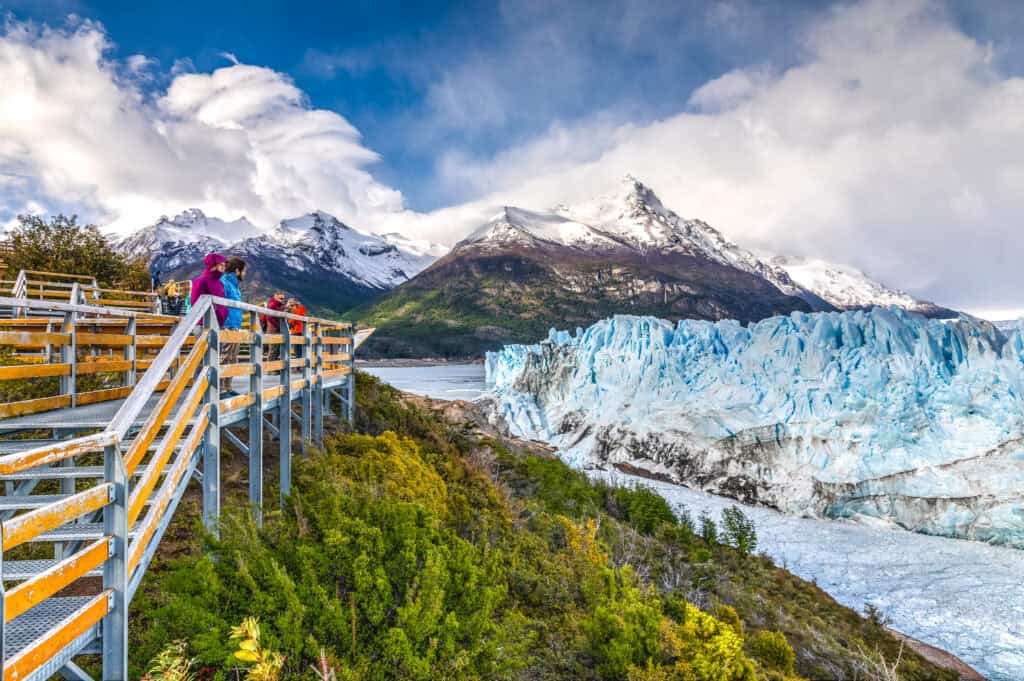
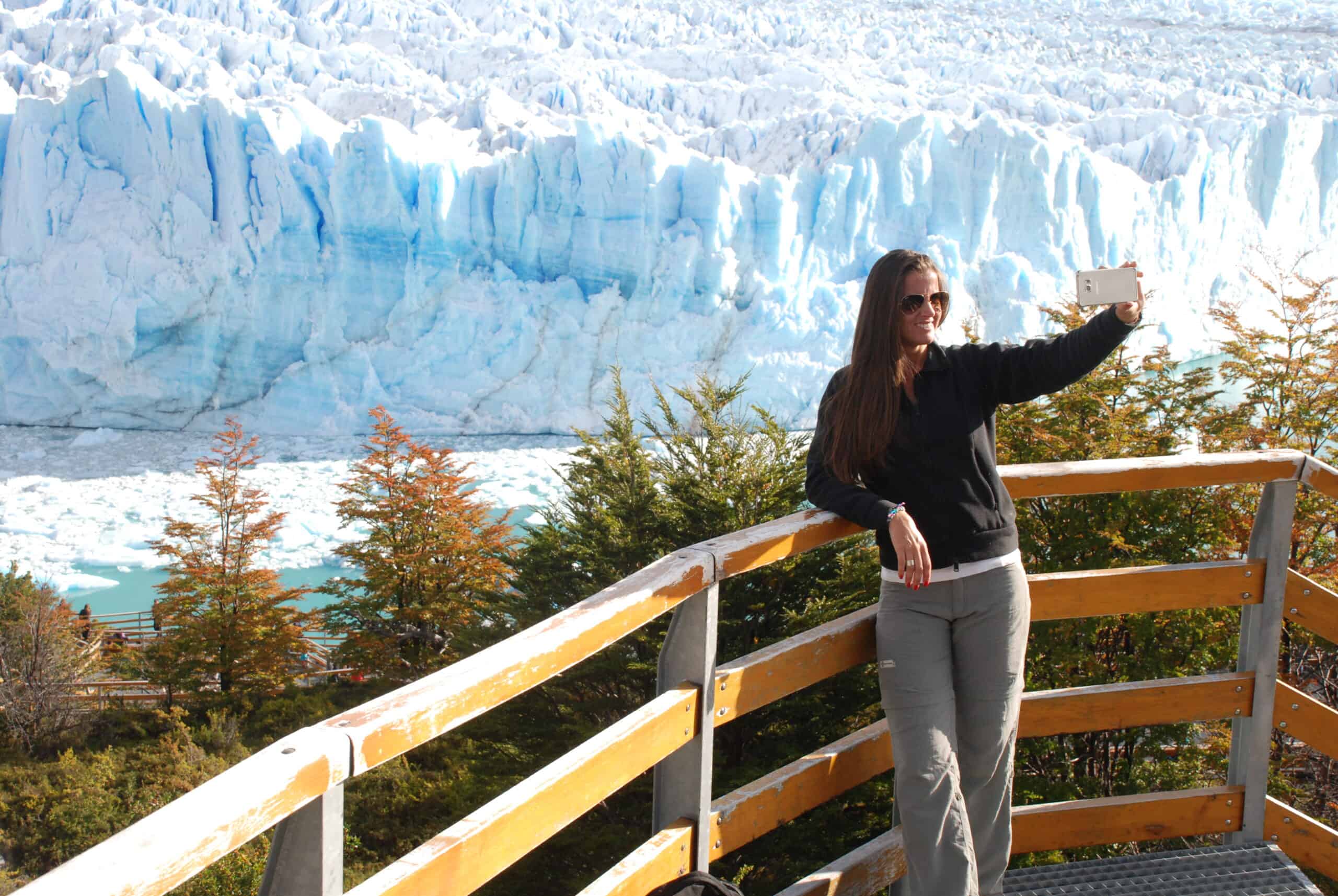
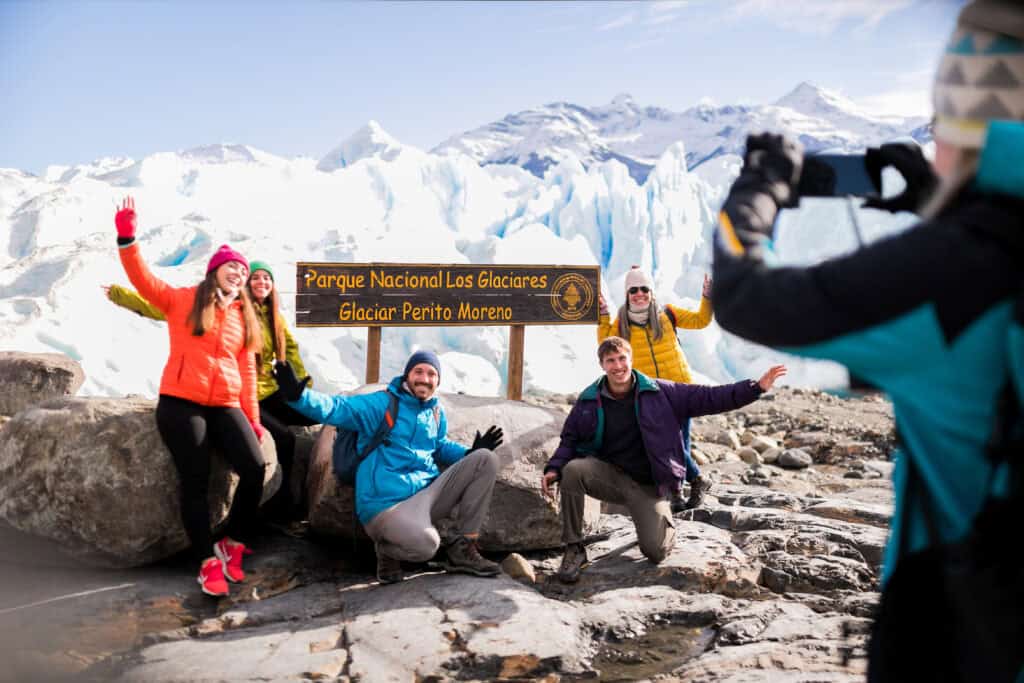
The most accessible way to see the glacier. You get there by minibus from El Calafate, pay the park entrance fee and walk the walkway circuits at your own pace. No age restriction, no special equipment. Duration 2 to 4 hours. Ideal for families with young children or older adults.
Minitrekking — 1 hour on the ice →
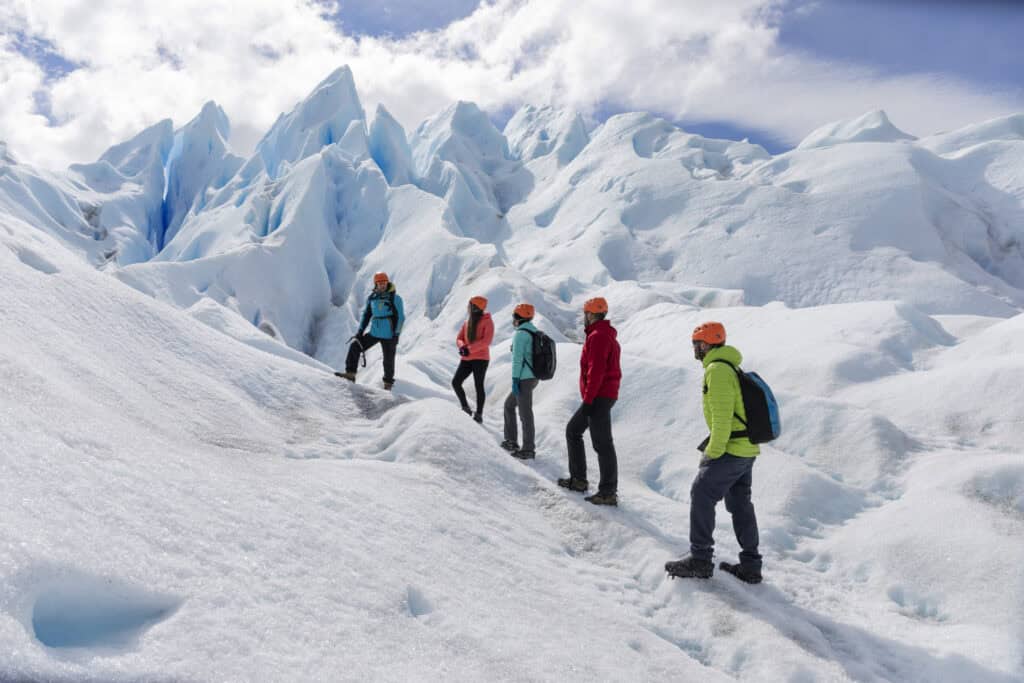
Includes the walkways plus a traverse of approximately 1 hour walking on the glacier with crampons (the guides give them to you and teach you how to use them). You navigate about 20 minutes to the boarding point. You walk through crevices, blue ice caves and views impossible from the walkways. Operates all year round. No prior experience required, just basic physical condition to walk 1 hour on uneven surface.
Big Ice — 4 hours on the ice →
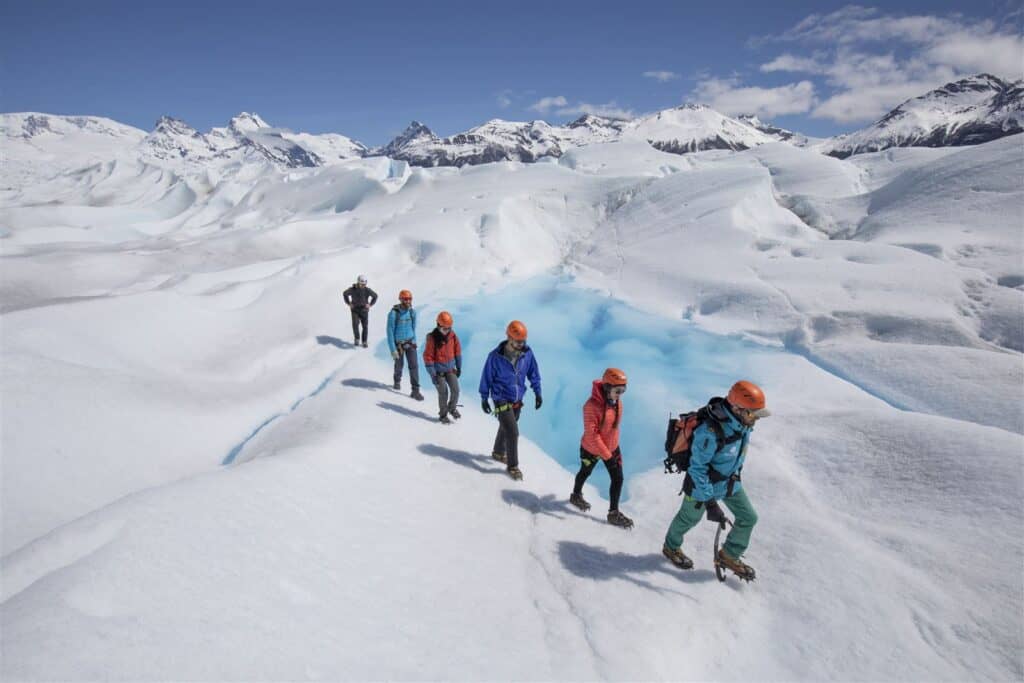
The extended version for more active travelers: 4 hours of trekking on the glacier with crampons, reaching interior zones inaccessible on the Minitrekking (spectacular ice formations and internal glacial lakes). Operates from October to April. Requires good physical fitness. Ages 18 to 50.
Safari Náutico — navigation facing the glacier →
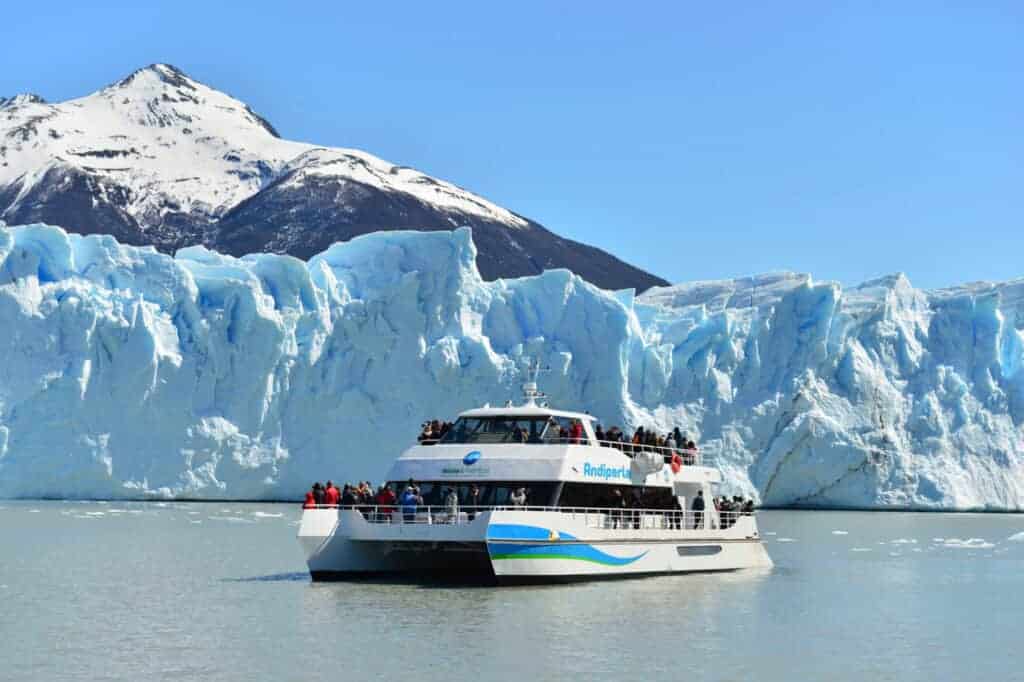
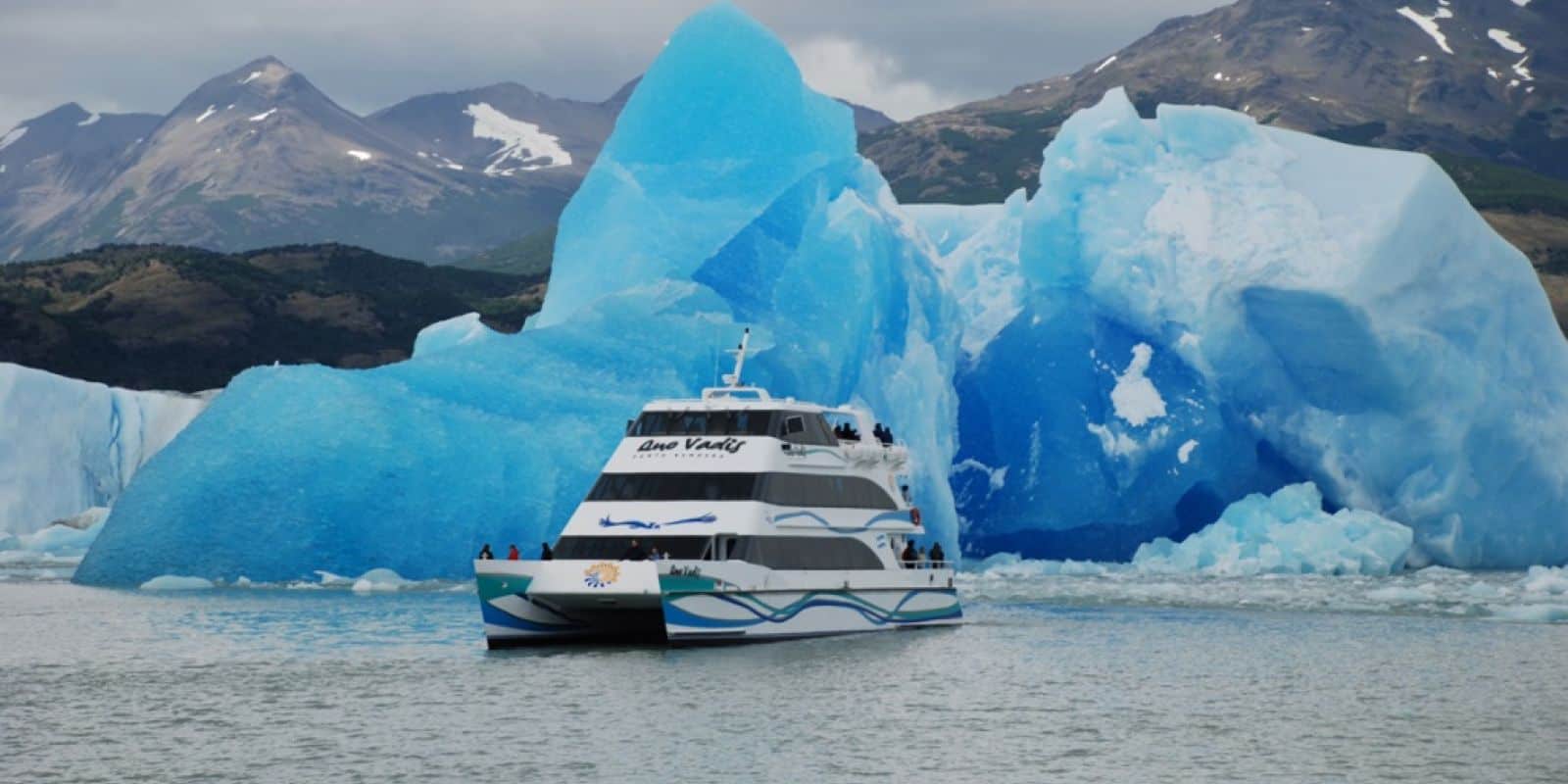
A 1-hour navigation facing the south face of the glacier, departing from Puerto Bajo Las Sombras. You see the ice wall and the calving from the water, with a perspective the walkways don't give, on a boat with panoramic windows. Suitable for all ages. Ideal if you visit El Calafate in your own car (with the option of transfer + walkways).
Safari Azul — Touch the Glacier →
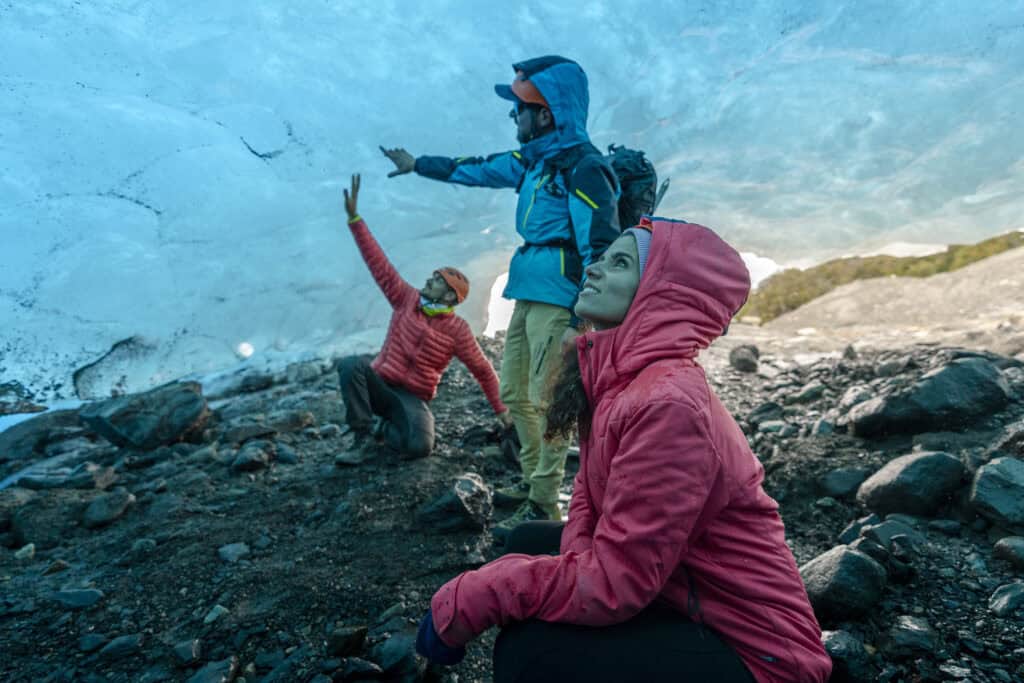
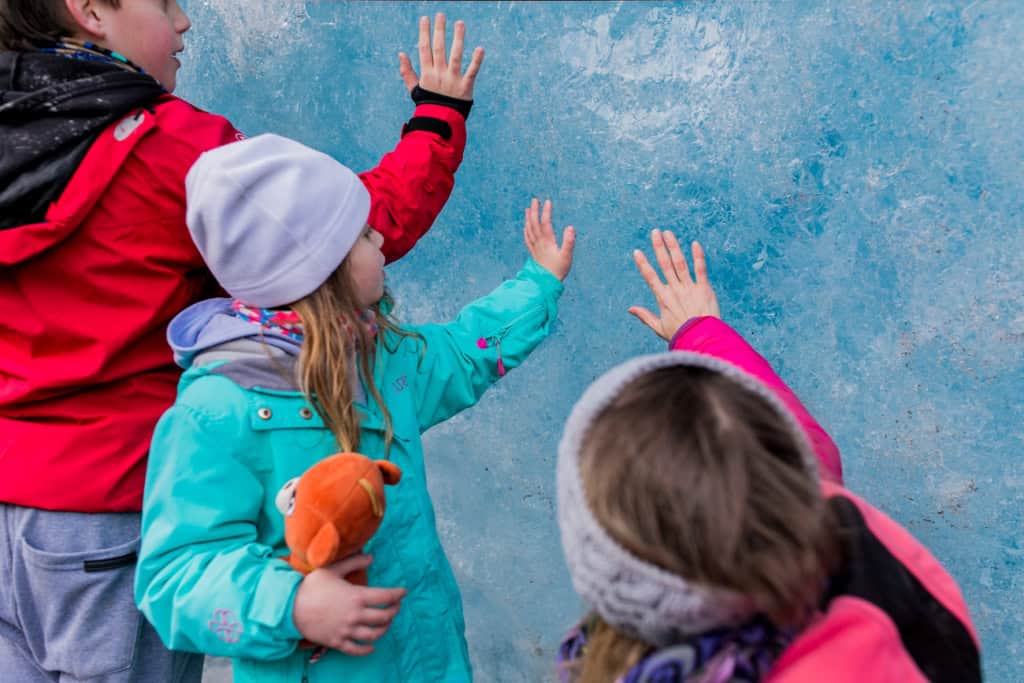
The closest experience to the glacier without stepping on the ice. From Puerto Bajo Las Sombras you navigate the Brazo Rico of Lago Argentino and walk through the Magellanic forest until you get close enough to touch the ancient ice of Perito Moreno. Includes 2 free hours on the panoramic walkways. Full day (8-9 hours), suitable for ages 6 to 70, no crampon trekking.
Quick comparison — which excursion to choose?
They all depart from El Calafate. The difference is how close to the ice you want to get and how much time and effort you have.
| Walkways | Safari Náutico | Safari Azul | Minitrekking | Big Ice | |
|---|---|---|---|---|---|
| Duration | 2–4 h | 1 h (boat) | 8–9 h | 9–10 h | 10–11 h |
| Ice contact | View only | From the water | You touch it | 1 h on the ice | 3–4 h on the ice |
| Boat ride | — | ✓ 1 hour | ✓ Brazo Rico | ✓ ~20 min | ✓ ~20 min |
| Fitness level | Low | Very low | Low–Medium | Medium | High |
| Suitable for | All ages | All ages | 6 to 70 years | 8 to 65 years | 18 to 50 years |
| Price from | $65,000 | $80.000 | $140.000 | $395.000 | $550.000 |
| Ideal if… | You want to see the glacier with no effort or extra cost | You want to see it from the water, without effort | You want to sail and touch the ice without crampons | You want to walk on the ice with crampons | You want the most complete experience on the ice |
Francisco Pascasio Moreno — The Perito who gave it his name (without seeing it)
The glacier doesn't bear the name of a president or a military figure. It honors a scientist and explorer: Francisco Pascasio Moreno (1852-1919), popularly known as "El Perito Moreno" for his role as an expert in defining the international borders between Argentina and Chile.
Moreno was born in Buenos Aires and showed an unusual passion for natural history and exploration from a very young age. At 17 he was already collecting fossils and shells on the shores of the Río de la Plata. At 25 he undertook his first great expedition to Patagonia, venturing into territories that no Argentine had scientifically explored.
In 1879, during his third Patagonian expedition, Moreno reached the shores of Lago Argentino — a lake he himself named to assert Argentine sovereignty — and explored the basins of the Santa Cruz river. He was the first explorer to scientifically describe the area where Los Glaciares National Park stands today.
Here it's worth separating myth from history, because almost everyone tells it wrong. Moreno never saw the glacier that bears his name. In 1877 he reached the shores of Lago Argentino and named it, but he never got to see the ice front. The first recorded European sighting of the glacier was by Chilean Navy captain Juan Tomás Rogers, in 1879. And the name "Perito Moreno" was given, in tribute, by lieutenant Alfredo Iglesias during his 1899 survey (formalized in his 1901 report) — decades after Moreno's visit to the lake.
Two clarifications that correct the most frequent mistakes: "Perito" is not a name or a nickname, it is a role — that of technical expert of the Boundary Commission with Chile — and the "P." in "Francisco P. Moreno" stands for his middle name, Pascasio, not for "Perito". Before "Perito Moreno" took hold, the glacier had other names: Rogers had called it "Francisco Gormaz" (after a Chilean hydrographer) and the geologist Rodolfo Hauthal named it "Bismarck", a name that still appears on some old German maps.
Francisco Moreno donated to the National State the lands he had been given as recognition for his scientific work — about 25 square leagues in Patagonia — so that they could be declared a national park. That altruistic gesture was one of the precursors of Argentina's national parks system. It was one of the largest land donations in Argentine history.
The formation of the glacier — 30,000 years of history
To understand how Perito Moreno formed, you need to travel to the end of the last Ice Age, about 18,000 years ago. At that time, all of Patagonia down to the Atlantic coast was covered by ice sheets several kilometers thick.
With the gradual warming that followed the glacial maximum, most of that ice receded. But in the Andes mountain range, where snowfall remains extremely high due to the collision of Pacific humid winds with the mountains, glaciers managed to survive.
The Southern Patagonian Ice Field — of which Perito Moreno is a part — is the third largest freshwater reserve on the planet, after Antarctica and Greenland. It consists of 13,000 km² of continuous ice over the mountain range, from which the 48 most important glaciers of Argentina and Chile flow towards the Atlantic and Pacific.
Perito Moreno flows from the Ice Field eastward, descending to Lago Argentino. Each year, snowfall in the higher elevations renews the ice lost at the face. In the highest part of the glacier, the ice can be up to 30,000 years old.
The phenomenon that made it famous — why did it stay in equilibrium for so long?
For nearly 80 years, between the mid-1940s and 2019, Perito Moreno kept a mass balance close to zero: it gained roughly as much from snow as it lost through melting and calving, and its front stayed practically in the same position. In a context where almost every glacier in the world was retreating, that stability made it a case study and fed the tourist narrative of "the glacier that doesn't shrink". (As you'll see below, that narrative is now out of date: since 2019 the glacier has started to retreat.)
Why did it achieve that equilibrium for so many decades? The answer combines several factors:
1. Balance between accumulation and ablation
A glacier grows when the accumulation of snow and ice exceeds losses through melting (ablation). Perito Moreno has the particularity that its feeding zone receives exceptionally high snowfall — several meters per year — which exactly compensated for the losses at the face.
2. The geometry of the lake
The face of Perito Moreno does not fall into deep water (which would accelerate melting from below), but at many points the base of the glacier rests on or is very close to the bed of Lago Argentino. This reduces the submarine calving that destroys other glaciers.
3. The Pacific winds
Humid Pacific winds collide with the mountain range and deposit enormous quantities of snow. Compared to other glaciers in the area, the wind system that feeds the Southern Patagonian Ice Field at the latitude of Perito Moreno is particularly efficient.
Glaciologists use Perito Moreno as a "witness" to understand what conditions allow a glacier to remain stable. If we could artificially replicate those conditions in other glaciers around the world, we could slow down the water crisis affecting millions of people who depend on glaciers for fresh water.
Historical timeline
Why is the glacier ice blue?
One of the most frequently asked questions by visitors standing in front of Perito Moreno is: why are some parts of the ice an intense blue?
The answer lies in the physics of light and the history of the ice. As snow accumulates layer upon layer over decades and centuries, the weight of the upper layers compresses the ice below. This compression process has two effects:
- It eliminates air bubbles trapped between ice crystals. Fresh ice (compacted snow) is white because the bubbles reflect light in all directions. Old, compressed ice has no bubbles.
- It reorients ice crystals into a denser, more regular structure.
Ice without bubbles absorbs all wavelengths of visible light except blue, which is reflected back to our eyes. That is why the oldest icebergs and the deepest crevices in the glacier display that photogenic electric blue. The more intense the blue, the older and more compressed the ice: it can be thousands of years old.
The oldest blue ice you will see on the walkways or during the Minitrekking is between 500 and 3,000 years old. To see 30,000-year-old ice you would need to drill down to the deepest layers of the Ice Field — something only glaciologists do with special scientific drills.
The historic ruptures — The spectacle of the century
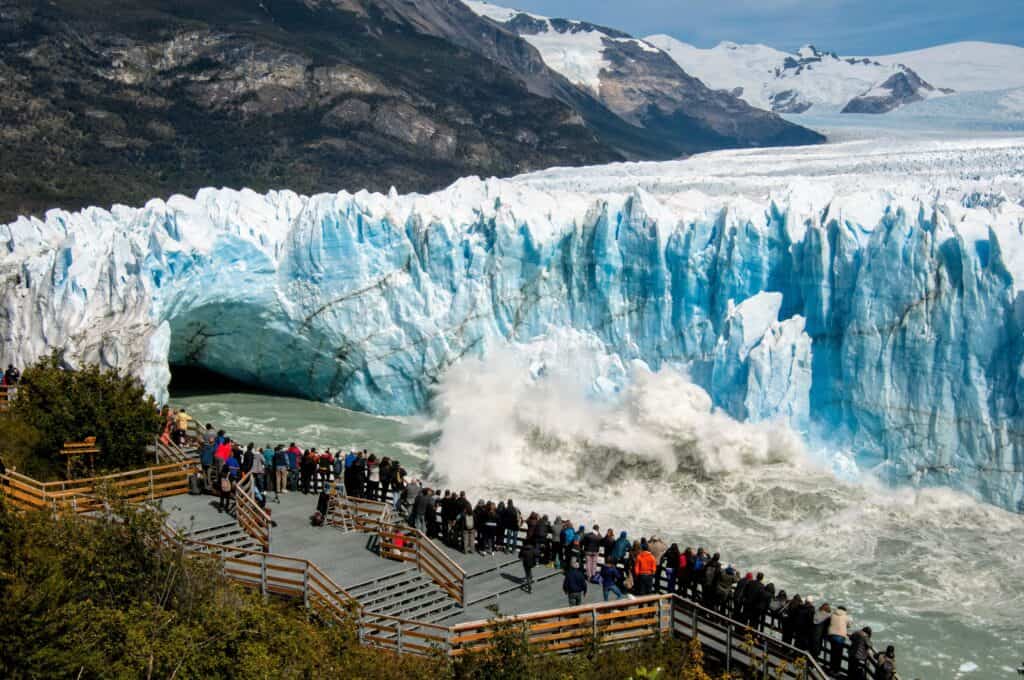
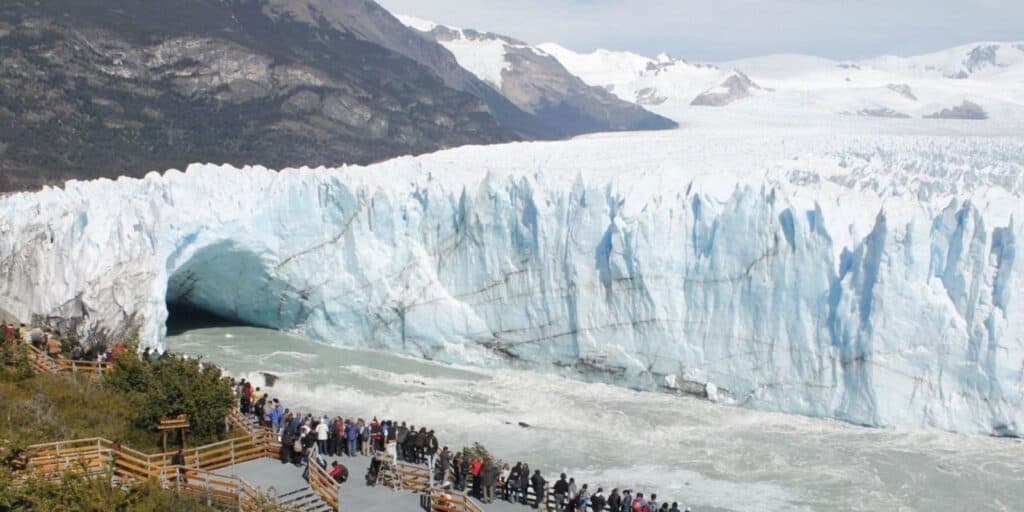
Periodically, Perito Moreno advances until it touches the Magallanes Peninsula, dividing Lago Argentino in two. The southern arm (Brazo Rico) becomes "dammed" behind the ice barrier and its level rises gradually. When the difference in level between Brazo Rico and the Main Lake exceeds a certain threshold (generally 10-15 meters), water begins to perforate the ice from below.
The process can last days or weeks. First an ice arch forms over the lake, beneath which water flows through a tunnel. That arch gradually loses ice at its base, thinning, until one day it collapses in a series of explosions that sound like thunder and generate enormous waves. It is one of the most impressive natural spectacles in South America.
Ruptures are unpredictable. There is no exact date. This causes many tourists to wait days on the walkways, hoping to be present when the event occurs.
Is Perito Moreno advancing or retreating? What science says in 2026
For decades the answer was "it's in equilibrium". Not anymore: Perito Moreno Glacier is retreating. After about 80 years of stability, it entered a documented retreat phase starting in 2019, and the famous narrative of "the glacier that grows while the others shrink" is now out of date.
The reference study was led by glaciologist Moritz Koch, together with Pedro Skvarca (from the Glaciarium museum) and Lucas Ruiz (from IANIGLA-CONICET), and was published in 2025 in the scientific journal Communications Earth & Environment. These are the figures it provides:
| Indicator | Before | Since 2019 |
|---|---|---|
| Thinning of the front | 0.34 m/year | 5.5 m/year (×16) |
| Retreat of the front | ~100 m total (2000–2019) | ~700 m/year (2021–2023) |
Does this mean the glacier will disappear tomorrow? No. What scientists say is more nuanced: Perito Moreno stopped being in equilibrium and has been retreating since around 2019, especially on its northern margin, and its recovery is unlikely in a context of climate change. But it is still standing, still a monumental spectacle and still in contact with the Magallanes Peninsula. Scenarios of rapid retreat of several kilometers are hypotheses expressed in the conditional by glaciologists, not accomplished facts.
Its neighbors are ahead in this trend: the Upsala Glacier — the longest in the park, at about 53 km — and the Viedma Glacier have been retreating markedly for years. Perito Moreno was for decades the great regional exception; today it is part of the same process affecting almost all Andean glaciers. This reality is part of the story our guides share with each group: Perito Moreno is not just a beautiful landscape, it is a living document of Earth's climate.
Argentina's Glacier Law
Argentina passed the National Glacier Law (Law 26,639) in 2010, which prohibits in glaciers and periglacial zones all activities that could affect them: mining, oil extraction, infrastructure projects, among others. It also mandates a national inventory of glaciers.
This law, driven by environmental and scientific organizations, is today considered one of the most comprehensive glacier protection laws in the world. However, its application has faced conflicts with mining interests in other provinces. In the Los Glaciares National Park area, protection is effective.
Myths and curiosities about Perito Moreno Glacier
Perito Moreno's fame drags along several myths that keep getting repeated in guides and on social media. Here are the most common ones, corrected, plus some facts almost nobody knows:
- Myth: "Moreno discovered the glacier". False. Moreno named Lago Argentino in 1877, but never saw the glacier. The first recorded European sighting was by Juan Tomás Rogers in 1879.
- Myth: "Perito was his name or his nickname". No: "Perito" was his role, that of expert of the Boundary Commission with Chile. The "P." in Francisco P. Moreno stands for Pascasio.
- Myth: "It ruptures every exactly 4 years". The periodicity of the ruptures is irregular: it can range from a couple of years to more than a decade. Between 1988 and 2004, 16 years passed without any rupture.
- Myth: "It's the only glacier in the world that grows". The correct version is that it maintained equilibrium for decades — it was not growing on a net basis — and today it is retreating.
- Curiosity — the calafate legend: "whoever eats calafate, comes back". It is a Tehuelche tradition and gives its name to the town of El Calafate.
- Curiosity — Moreno the linguist: he took notes on the Tehuelche language and tried to put together a dictionary.
Perito Moreno National Park, in the north of Santa Cruz, is about 560 km from the glacier and is not the Perito Moreno Glacier. For years digital maps mixed up the two places, and there are still travelers who end up at the wrong destination. If your plan is to see or walk on the ice, the place is El Calafate, not the park in the north.
The glacier walkways — 3 circuits for all levels
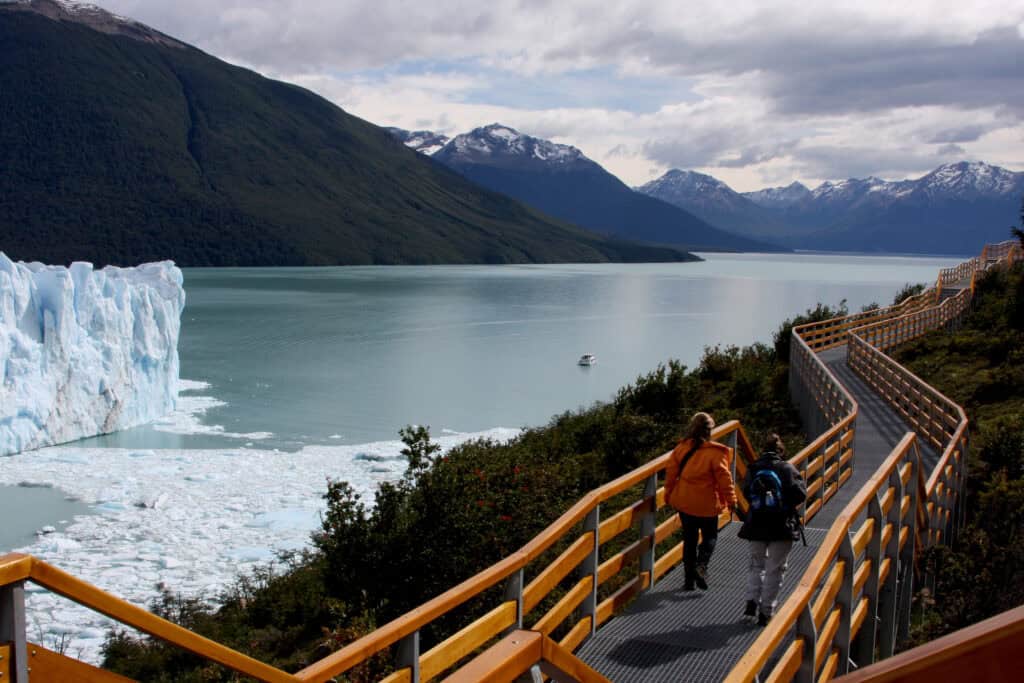
Since 1988, Los Glaciares National Park has had a system of wooden walkways that allow visitors to approach the glacier's face safely. Today those walkways extend for about 5.5 km in three differentiated circuits, each with its own visual angle and level of physical demand.
Upper Circuit — the full panoramic view
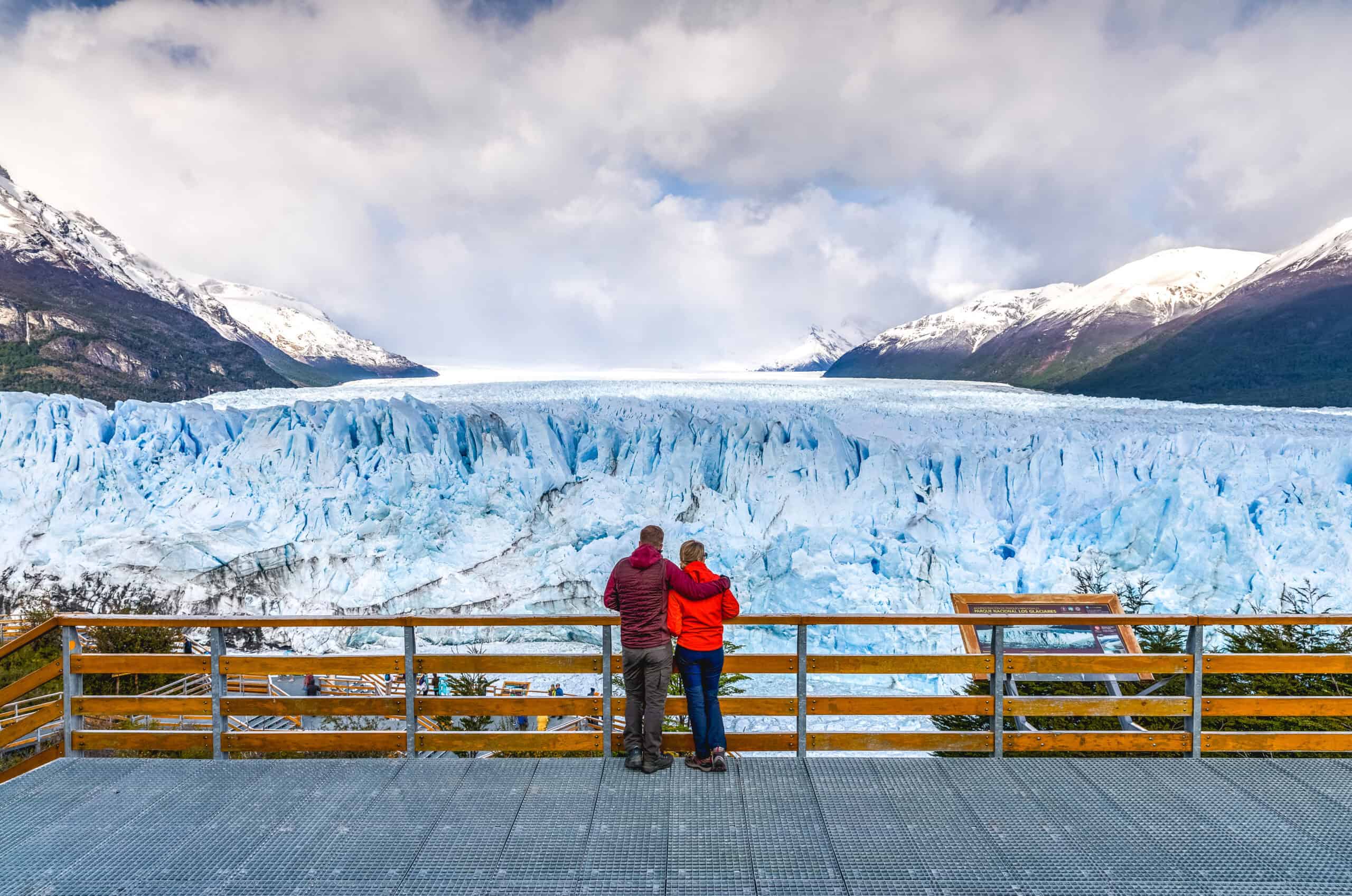
The Upper Circuit is the longest and climbs the highest in altitude, reaching the upper viewpoints from where you can see the complete 5 km-wide face of the glacier. From above, the scale of Perito Moreno becomes comprehensible in a way that is not possible from below: it's like seeing a map made of living ice. The complete route takes between 2 and 3 hours at a leisurely pace. It is the favorite of photographers for the visual breadth.
Lower Circuit — face to face with the face
The Lower Circuit descends to the level of Lago Argentino and puts you at water level in front of the glacier face. From here the 60 to 70-meter wall of ice is experienced in all its monumentality. Ice calving events — the "calving" — are heard and felt in the chest like short thunderclaps. The water level and the shoreline allow you to see in detail the oldest blue ice at the glacier's base. Estimated time: 1 to 1.5 hours.
Central Trail — the direct view to Brazo Rico
The Central Trail offers the most direct perspective on the sector where the glacier meets the Magallanes Peninsula. It is from this circuit that the rupture process can best be observed when it occurs: the Brazo Rico arm of the lake is to the south, dammed by the ice wall. In years of advance, the connection between the glacier and the peninsula is visible from here. Estimated time: 45 minutes to 1 hour.
If you have time, do all three circuits. Each shows a different Perito Moreno. If you can only do one, the Lower Circuit is the one that leaves the deepest impression: standing at water level in front of a 70-meter ice wall is an experience that has no equivalent. The Upper Circuit is ideal to combine with the Lower if you set out early.
⚠️ Access to the walkways is included in the National Park entry fee. The Minitrekking price does not include the park entry — it must be paid separately. The walkways are free once inside the park. In summer the park may limit entry due to maximum capacity — it is always advisable to arrive before 10:00.
The experience of being in front of the glacier — what you really feel
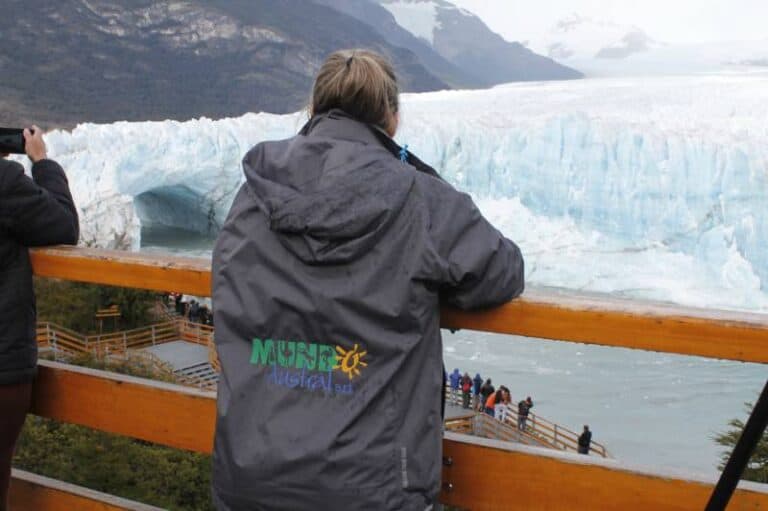
No photo or video fully prepares you for the first time you stand in front of Perito Moreno. The experience is multisensory, and that is exactly what makes it so difficult to describe.
The scale that doesn't fit in the frame
The glacier face is 5 km wide and between 60 and 70 meters tall above the water. To put it in perspective: it's like a 20-story building extending for four times the length of the Estadio Monumental in Buenos Aires. Photos compress that scale. Only when you see a person standing on the walkways beside the ice do you understand what size we're talking about.
The sounds of the ice
The glacier makes noise. Constantly. There is a background creaking — like the sound of a settling house, but multiplied — that comes from the internal movement of the ice. And then there are the thunderclaps. Every so often, without warning, a section of the wall breaks off and falls into the lake with a detonation that you feel in your ribcage before you hear it. The reaction time is zero: the ice is already in the water when your brain processes the sound. For many travelers, this is the most impressive moment of the entire Patagonia trip.
The silence between sounds
Between the thunderclaps of calving, Perito Moreno has a stillness that feels almost threatening. The lake has no waves of its own. The glacier doesn't move at a visible speed. It is a dense, blue, cold silence. Many visitors who came for just half an hour end up staying two or three hours, hypnotized.
🌡️ The glacier's microclimate: When you are on the walkways, the perceived temperature can be 5 to 8°C lower than in El Calafate town. The air coming down from the ice is genuinely cold, even in January. Always bring a jacket, even if the day seems warm when you leave the hotel.
Where to stay in El Calafate: Apart Mundo Austral
Brand-new apartments in the heart of El Calafate. Full kitchen, WiFi, Smart TV + Netflix, central heating and free private parking. Minimum 3 nights. From $50,000 ARS/night (up to 2 people).
By staying with Mundo Austral you can book your excursions directly with the agency — no middlemen, at the best price.
View Apart and availability → 💬 Contact via WhatsApp
Packages and Combos in El Calafate
If you want to make the most of every day and save money, Mundo Austral has packages that combine airport transfers + excursions. Buying the combo works out better than booking each thing separately.
Frequently asked questions
Experience history in person
You can read about Perito Moreno or you can stand in front of it. We recommend the latter. Book your excursion with Mundo Austral: the panoramic walkways, the Minitrekking, Big Ice, kayaking in front of the glacier or the Nautical Safari. And if you want the full picture, check out all the excursions in El Calafate.