What is the Todo Glaciares?
The "Todo Glaciares" is the most ambitious navigation excursion you can do from El Calafate. The name says it all: in a single day you navigate to the three most imposing glaciers on Lago Argentino besides Perito Moreno: Upsala, Spegazzini and Onelli glacier. All of them lie within Los Glaciares National Park, a UNESCO World Heritage Site since 1981, in the province of Santa Cruz.
Lago Argentino is the largest freshwater lake in Argentina, with 1,415 km² of surface area. Its waters come directly from the melting of the glaciers of the Southern Patagonian Ice Field, which gives them that characteristic milky turquoise colour, produced by the ground rock (glacial flour) they carry in suspension.
The excursion departs from Puerto Bandera, 45 km west of El Calafate. The bus journey to the port takes about 45 minutes and boarding is at 9:00. From that moment you begin to navigate the North Arm of the lake, one of the most extensive and least frequented arms.
Puerto Bandera got its name because it was the point where the Argentine flag was raised during the demarcation of the border with Chile in the late 19th century. Lago Argentino was also "named" in that context to mark sovereignty. Every place name in this area has a history of exploration and international diplomacy.
The glaciers you will see
🏔️ Upsala Glacier — The most extensive in South America
The Upsala is the colossus of the Southern Patagonian Ice Field. Its name was given in 1908 by Swedish geologist Klaus August Jacobson, in honour of the city of Uppsala and its university, which was a pioneer in glaciological studies of the Patagonian region. With its 53.7 km in length, it is considered the third longest glacier in South America and one of the three great glaciers of the Southern Patagonian Ice Field, along with Viedma and Perito Moreno. What you will see from the boat is its calving front: an ice wall up to 60 metres high from which building-sized blocks periodically break off.
In recent decades, the Upsala has retreated alarmingly — more than 4 km since the mid-20th century — unlike Perito Moreno. This difference is one of the topics the on-board guide explains in detail, and it is fascinating to understand why one glacier advances while its neighbours retreat.
🏔️ Spegazzini Glacier — The tallest in the Park
The Spegazzini bears the name of Italian botanist Carlo Spegazzini, one of the first scientists to study Patagonian flora. Its front is impressive: up to 135 metres above water level, making it the tallest glacier visible from the lake. Comparing it to Perito Moreno (60-70 metres) gives an idea of its scale.
The texture of the Spegazzini ice is also different: more greyish, marked by lateral moraines (accumulations of rock and earth that glaciers drag in their movement). It is a glacier that "worked hard" for millennia.
Depending on the operator and the circuit version, some boats include a landing at Base Spegazzini — a point on the shore with viewpoints and short walkways that allow you to see the glacier front from land. The Refugio Spegazzini operates there as a rest area with panoramic views. If your operator includes this landing, it is a very worthwhile stop: changing perspective from the water to the land in front of the tallest glacier in the park is a very different experience. Ask when booking whether your circuit includes it.
The iceberg spectacle
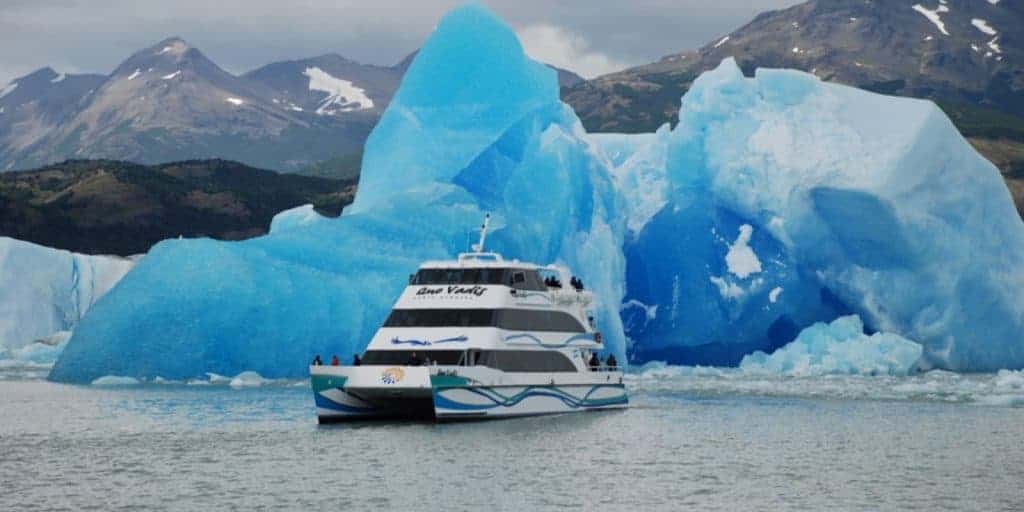
One of the most impressive moments of the Todo Glaciares is not necessarily reaching the glaciers, but the journey between them: navigating among giant drifting icebergs on Lago Argentino.
The icebergs of Lago Argentino break off from the glacier fronts in a process called calving. 90% of an iceberg's mass is below the water. What you see from the boat is just the tip. The colours range from pure white to intense blue, through greens and greys depending on the compression of the ice and trapped sediments.
The boat navigates among the icebergs always maintaining safe distances. The captain has years of experience recognising which icebergs are stable and which are about to break off or capsize (a process that generates waves and sounds like thunder). When an iceberg capsizes, the energy released is equivalent to several tonnes of TNT.
Blue icebergs are the oldest and most compressed. The blue colour of ice is not pigment: ice compressed over thousands of years absorbs all wavelengths of light except blue, which is reflected back to our eyes. The more intense the blue, the older and denser the ice. A brilliantly blue iceberg can be tens of thousands of years old.
Step-by-step day programme
- 7:30–8:00 — Pick-up at hotel or meeting point in El Calafate.
- 8:00–8:45 — Bus journey to Puerto Bandera (45 km, Route 40 to the northwest). The guide gives information about the day during the journey.
- 9:00 — Boarding at Puerto Bandera. Welcome on board, seat assignment, safety instructions.
- 9:00–11:00 — Navigation along the North Arm of Lago Argentino. First icebergs appear. Views of Cerro Bertrand and other Andean peaks.
- 11:00–12:30 — Arrival at the Upsala glacier area. The boat approaches the front, the guide explains the history and science of the glacier. Snack service on board.
- 12:30–13:30 — Navigation through the Canal de los Témpanos (Iceberg Channel). The silence is broken only by the creaking of ice.
- 13:30–15:00 — Landing at Bahía Onelli. 45-minute walk to Laguna Onelli, surrounded by glaciers. Lunch at the park refuge (included in some circuit versions).
- 15:00–16:30 — Navigation towards Spegazzini glacier. This is the furthest point of the excursion.
- 16:30–17:30 — View of Spegazzini: the highest ice wall of the entire circuit. The boat stops in front of the glacier so passengers can photograph and listen to the sounds of the ice.
- 17:30–19:00 — Navigation back to Puerto Bandera.
- 19:00–20:00 — Bus back to El Calafate.
How does it differ from Perito Moreno?
This is the question we get asked most by travellers. The short answer: they are completely different and complementary experiences. They are not mutually exclusive.
| Feature | Todo Glaciares | Perito Moreno (Walkways) |
|---|---|---|
| Type | Boat navigation | Land walkways |
| Duration | 10–11 hours | 2–4 hours |
| Glaciers | Upsala + Spegazzini + Onelli | Perito Moreno |
| Walk on the ice | No | No (yes with Minitrekking) |
| Icebergs | Many (you navigate among them) | Some visible from a distance |
| 2026 price | $240,000 ARS | Park entry + transfer |
| Physical fitness | No requirements | Easy walk |
| Best for | Epic landscape from the water | Close-up experience of the glacier |
💡 Recommendation: If you have more than 3 days in El Calafate, do both excursions. They are so different that one does not replace the other. Many travellers who only do one wish they had done both.
Clothing and gear for the navigation
The golden rule of navigating on Lago Argentino: it is cold. Even in summer, when El Calafate has 20°C, on the lake the temperature can be 8-10°C lower due to the wind and proximity to the glaciers. Many tourists arrived at the boat in a t-shirt and regretted not having brought warm clothing.
- Windproof jacket (essential for the deck)
- Fleece or thick sweater to wear under the jacket
- Hat and gloves, even in December
- Sunscreen and sunglasses — the reflection from water and ice is intense
- Camera / GoPro — the icebergs are photogenic and the light on the lake is spectacular
- Seasickness tablets if you are prone (the lake can have waves)
- Refillable water bottle
- Some food, although the boat has a cafeteria
The outdoor deck is the best place for photos, but the wind can be very strong near the glaciers. Always use your camera strap. We have seen cameras and lenses fly into the water from an unexpected gust. No joke.
2026 prices and bookings
The price of the Todo Glaciares excursion in 2026 is $240,000 ARS per person. The price range depends on the operator and whether it includes:
- Transfer from your hotel in El Calafate to Puerto Bandera
- Lunch at Bahía Onelli (some circuits include it)
- Bilingual guide service on board
What is generally not included:
- Los Glaciares National Park entry (2026: non-resident foreigners $50,000 ARS; Argentine residents $25,000; Santa Cruz residents $8,000)
- Alcoholic drinks on board
- Tips for the boat crew
It is recommended to book at least 72 hours in advance in high season, as boats have a fixed capacity and tend to fill up.
Glaciers along the way — Heim and Peineta
Upsala and Spegazzini are the stars of the route, but they are not the only glaciers you will pass during the navigation. On the journey between the Upsala sector and Bahía Onelli, the boat passes near two glaciers that few travellers know by name but that everyone photographs:
Heim Glacier
Heim Glacier descends from the slopes of the National Park with a relatively narrow tongue and a very crevassed surface (full of cracks). Its front calves directly into the lake, generating small icebergs that drift in the waters of the Channel. It is a "hard-working" glacier whose texture shows the internal activity of the ice in a very visual way. The on-board guide usually points it out and compares it with the Upsala to show the difference in scale.
Peineta Glacier
Peineta Glacier gets its name from its characteristic shape from above: the striations of the ice resemble the teeth of a comb (peineta in Spanish). It is smaller than Heim but visually striking because of the way the lateral moraines frame its ice tongue. From the boat, the combination of the bluish-white ice with the black rock walls on the sides creates a spectacular photographic contrast.
When the guide announces you are approaching the Heim and Peineta glaciers, position yourself at the bow of the upper deck and have your camera ready focused on the horizon. These glaciers pass into view in minutes — the boat does not stop as it does at the Upsala. It is a quick shot but worth it.
Bahía Onelli — The hidden gem of the Todo Glaciares
If we had to choose our favourite moment of the entire excursion, many El Calafate guides would say the same thing: the stop at Bahía Onelli. However, it is also the stop that most travellers underestimate or simply miss because they stay at the dock to eat.
Bahía Onelli is a small sheltered cove where the boat moors for approximately an hour and a half. From the dock, a flat 45-minute trail crosses a forest of Patagonian lenga and ñire beech trees to reach Laguna Onelli: a mirror of cold water surrounded by three smaller glaciers (Agassiz, Bolados and Onelli itself) and full of small drifting icebergs. It is a scene that looks like it comes from another planet.
The three glaciers of the lagoon
Unlike Upsala and Spegazzini, which are seen from the water, the glaciers of Laguna Onelli can be observed face-on from the shore. The Agassiz glacier descends from the northwest with a narrow, very blue tongue. The Bolados glacier appears further north, with a more fractured surface and well-defined lateral moraines. The Onelli glacier, the most visible, calves directly into the lagoon generating the small icebergs that float just metres from where you will be standing.
The scale is completely different from that of the Upsala. These are smaller, more intimate glaciers that you can observe calmly. There are no engine sounds or the movement of a boat: just the wind, the creaking of ice and, if you are lucky, the crash of a mini-calving.
Wildlife at Bahía Onelli
The trail to the lagoon is also a Patagonian wildlife corridor. It is common to see upland geese (cauquenes) on the banks of the streams that cross the path. In the skies above the lagoon, condors use the thermals generated by the glaciers to soar effortlessly. Steamer ducks, black-faced ibis and, less frequently, grey foxes prowling the edges of the forest are also spotted.
The Bahía Onelli refuge is right at the beginning of the trail, before the forest starts. A small restaurant there serves a daily set menu, hot drinks and basic souvenirs. In some circuit versions lunch is included; in others it is paid separately. Prices are similar to those on the boat — no unpleasant surprises.
The walk to Laguna Onelli is almost flat and takes 45 minutes. Many tourists stay at the dock to eat, missing the best moment of the entire excursion. Do the walk. Without a doubt.
Puerto Bandera — The Todo Glaciares embarkation point
Puerto Bandera is the starting point of the whole adventure. It is located 45 km northwest of El Calafate, following National Route 40 north and then taking a gravel road to the shore of the North Arm of Lago Argentino. The landscape along the way already hints at what is to come: Patagonian steppe, reddish hills and, if the day is clear, the first glimpses of the snow-capped mountains in the background.
The bus journey to the dock
The bus transfer from El Calafate to Puerto Bandera takes about 45-50 minutes. The first stretch on Route 40 is asphalt; the last few kilometres are well-maintained gravel but with some dust in summer. The guide uses the journey to talk about the historical, geological and scientific context of what you will see during the day.
On the way it is very common to see guanacos grazing near the road, sometimes in groups of 10 or 15 animals. Also rheas, Patagonian hares and, occasionally, pumas crossing from a distance. Ask the driver to point things out if he sees something: he usually knows the spots where wildlife appears most often.
A practical tip: sit on the left side of the bus on the way there for better views of the lake as you approach. On the way back, the best views are on the right side.
The dock and boarding
Puerto Bandera is a small, functional dock without the infrastructure of a large tourist port. There are toilets, a covered waiting area and a small café. Boarding is orderly and quick. The catamarans that do the excursion have capacity for 80 to 120 passengers depending on the operator.
The name "Puerto Bandera" has an interesting history: it was the point where the Argentine flag was raised for the first time during the border demarcation work with Chile in the late 19th century. In that context Lago Argentino was also given its name, to assert sovereignty over the disputed waters. Every place name in this area has layers of history of exploration, diplomacy and Patagonian politics.
In the small lagoon next to the access road to Puerto Bandera, it is common to see Chilean flamingos (Phoenicopterus chilensis) from October to March. If the bus passes by at dawn, it is a spectacular display of pink against the light blue of the lake. Ask the driver to slow down if he sees them.
The retreat of Upsala Glacier — A climate change story
There is something that changes when you are standing on the boat deck in front of the Upsala and the guide explains that where you see water today, 70 years ago there was solid ice. The Upsala glacier has retreated more than 4 km since the mid-20th century. It is not an abstract statistic: it is visible, measurable, and generates a feeling that is difficult to describe.
Why does Upsala retreat while Perito Moreno does not?
This is the million-dollar question, and the answer is fascinating because it is not solely about temperature. Perito Moreno calves into a relatively shallow lake zone (200-300 m) and its front is "anchored" on a sedimentary bank that gives it stability. Upsala, on the other hand, calves into a lake zone with depths of up to 900 metres. This depth allows the lake water — which at the bottom has slightly higher temperatures — to undercut the base of the glacier, accelerating calving and retreat.
Added to this are changes in wind patterns (Patagonian westerly winds have intensified in recent decades, affecting temperature and precipitation in the area), reduced snow accumulation in the glacier's feeding zone, and internal ice dynamics that scientists are still studying.
What you will see: the new bay
The retreat of the Upsala created a new bay that did not exist on maps 50 years ago. When the boat enters this area, you are literally navigating in a space that was solid ice in your grandparents' time. The landscape has a strange beauty: freshly calved icebergs floating in turquoise water, "dead ice" (blocks stranded on the shore) and lateral rock walls striated by the glacier as it retreated.
CONAE (Argentina's National Space Activities Commission) and CONICET carry out continuous satellite monitoring of the Upsala. The data is conclusive: the glacier front position in 1979 was almost 10 kilometres from where it is today. And the acceleration of the retreat is alarming: between 2008 and 2011, the Upsala retreated 2.9 kilometres in just three years, as well as losing thickness. The glacier loses between 100 and 400 metres per year depending on annual weather conditions.
💡 Unique perspective: Comparing the Upsala with Perito Moreno on the same trip to El Calafate gives you a unique perspective on climate change. They are two glaciers from the same system, fed by the same ice field, that behave in completely different ways. One advances (or remains stable); the other retreats rapidly. Seeing both in person is something no statistic or documentary can replace.
The emotional impact: a living glacier vs. one in retreat
Many travellers describe the visit to the Upsala as an emotionally different experience from the Perito Moreno. Perito Moreno generates awe and adrenaline: it is massive, active, it roars. The Upsala generates something closer to melancholy. The new bay created by its retreat, the blocks of "dead ice" stranded on the shore, the silence... everything communicates something that is hard to articulate but stays with you. It is not a political message or a speech; it is simply nature showing what is happening.
Todo Glaciares for different traveller profiles
The Todo Glaciares excursion is one of the few that works very well for very different types of travellers. Here are our recommendations depending on who you are:
📷 For photographers
The Todo Glaciares is one of the best photographic settings in Patagonia. The best light moments are the first hours of navigation (lateral light on the icebergs) and the return at sunset. Bring a wide-angle lens for the full glaciers and a telephoto for ice texture details and wildlife. The ideal position on the boat is the bow of the upper deck, where the angle towards the glaciers is not blocked by the boat's structure. Arrive at boarding early to secure that spot.
👨👩👧 For families with children
The excursion is long (10-11 hours) but manageable for children aged 6 and over. The boat has a heated indoor lounge where children can rest between sights. The Bahía Onelli stop usually delights children: the walk is short and flat, and seeing the mini-icebergs of the lagoon from the shore is something that stays in their memory. Bring your own snacks for the little ones, as the boat has limited options for them.
🔬 For curious travellers or those with a scientific interest
The on-board guide explains in detail the geology, glaciology and scientific history of each glacier. If you are the type who wants to understand the "why" of everything, this excursion is especially rich. Ask about the retreat of the Upsala, about the difference between lateral and frontal moraines, about how blue icebergs form. The guides on the Todo Glaciares boats usually have a remarkable level of technical knowledge.
🧓 For elderly visitors or those with reduced mobility
The boat itself is accessible and comfortable. The only part requiring some physical effort is the walk to Laguna Onelli, which can be skipped without any problem: staying at the Bahía Onelli refuge to have a drink is perfectly fine. Let the operator know when booking so they can make the necessary adjustments and reserve you a comfortable spot on board. The excursion overall is low physical impact compared to any trekking.
🏔️ For those who have already done Perito Moreno
If you have already been to Perito Moreno and wonder whether the Todo Glaciares will feel like "more of the same", the answer is no. They are completely different experiences: one is land-based (walkways, physical proximity to the ice, calving sounds metres away), the other is maritime (panoramic perspective, multiple glaciers, drifting icebergs, stop at Onelli). The Todo Glaciares expands the understanding of the glacier system in a way that Perito Moreno alone cannot provide.
What happens if the weather is bad
Lago Argentino has 1,466 km² of open water surface. That means that when the Patagonian wind blows hard (and in El Calafate the wind is a major player for much of the year), the lake can generate considerable waves. The Todo Glaciares boats are designed for those conditions, but safety is always the number one priority.
How often is it cancelled?
Full cancellation of the Todo Glaciares due to weather conditions is relatively infrequent in high season. The captains have decades of experience navigating Lago Argentino and know conditions with great precision. With moderate wind, cancellation is not the most common response — adaptation is: changing the order of glaciers visited, shortening time in the most exposed area or navigating close to the shore where there is more shelter.
The most likely cancellations occur in the low season (May to August), where the combination of wind, rain and lower demand can lead to not operating for consecutive days. In winter, always check 24-48 hours in advance whether your departure is confirmed.
How to check conditions
The night before your excursion, you can check the forecast on Windy.com (filtering by El Calafate or by Lago Argentino's coordinates) or contact the operator directly. They have first-hand information on expected conditions for the next day. Most operators give notice several hours in advance if there is a cancellation.
What happens if it is cancelled?
In the event of cancellation due to weather conditions, the most common policy is rescheduling (at no additional charge) or a full refund. Nothing is charged if the operator cancels for safety reasons. Verify the specific policy when booking.
If the cancellation catches you with no possibility of rescheduling (last day before departure, for example), the most popular alternatives are:
- Perito Moreno Glacier excursion — operates regardless of the lake's state, as it is land-based.
- Safari Azul — shorter navigation on the Brazo Rico (more sheltered from the wind).
- Laguna Nimez or the historic centre of El Calafate for a quieter day.
⚠️ Important: The Todo Glaciares is very rarely cancelled in high season. The captains have decades of experience on Lago Argentino and make conservative but accurate decisions. However, if you travel in winter or the low season (June to August), the probability of not operating is higher. Always confirm the departure with the operator the night before.
| Period | Operation | Availability | Recommendation |
|---|---|---|---|
| Dec – Feb (peak) | Daily | High — book 3-5 days ahead | Ideal, long days and warmer |
| Oct – Nov / Mar – Apr | Almost daily | Good — book 48h ahead | Highly recommended, fewer crowds |
| May – Sep (low) | Variable / reduced | Low — check availability | Confirm with operator; shorter days |
Frequently asked questions
Navigate among glaciers and giant icebergs
The Todo Glaciares is one of the most impressive nature experiences in South America. Book your place with the El Calafate specialists. If you enjoy boat trips and Perito Moreno, you can also add the Nautical Safari, the Big Ice or kayaking in front of the glacier, or see all excursions in El Calafate.